
From the vineyard to the next generation
LIFE RESOURCES
Life Resources is the sustainability framework of Grape Evolution. It brings together science, breeding and agronomy to answer a simple question: how can table grape production stay viable while protecting the land, water and air that future generations depend on?
Our land, our future
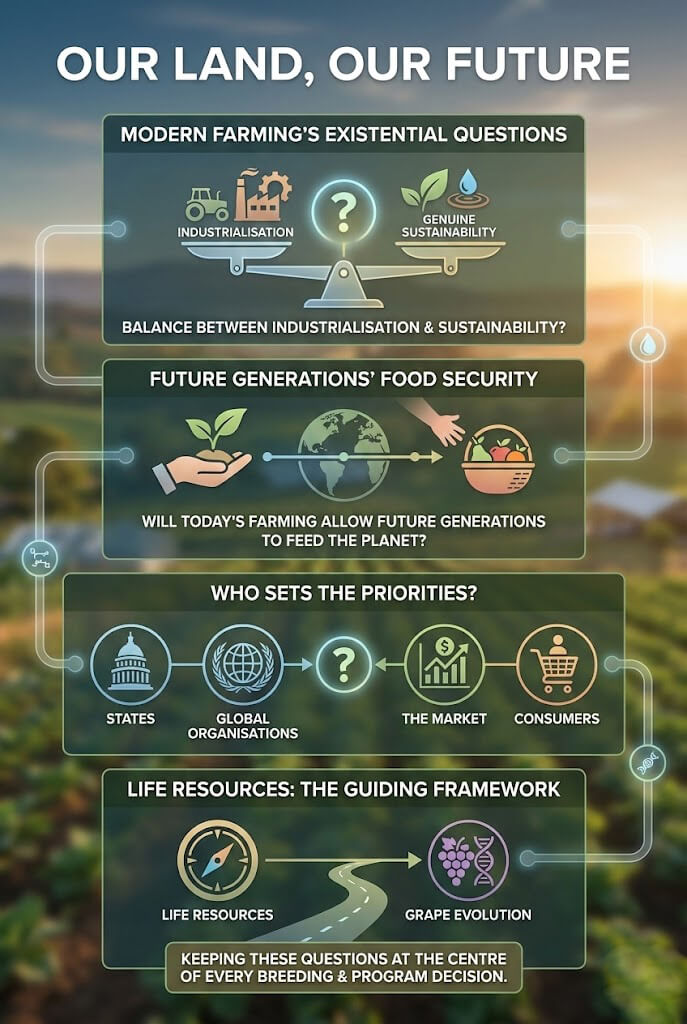
Modern farming can no longer be measured by yield alone. It must respond to deeper, existential questions:
How do we achieve a balance between farm industrialisation and genuine environmental sustainability?
Will the way we farm today allow future generations to continue feeding the people of this planet?
Who truly sets the priorities: states, global organisations, the market, or the consumers?
Life Resources exists to keep these questions at the centre of every breeding and program decision at Grape Evolution.
The scientific mandate
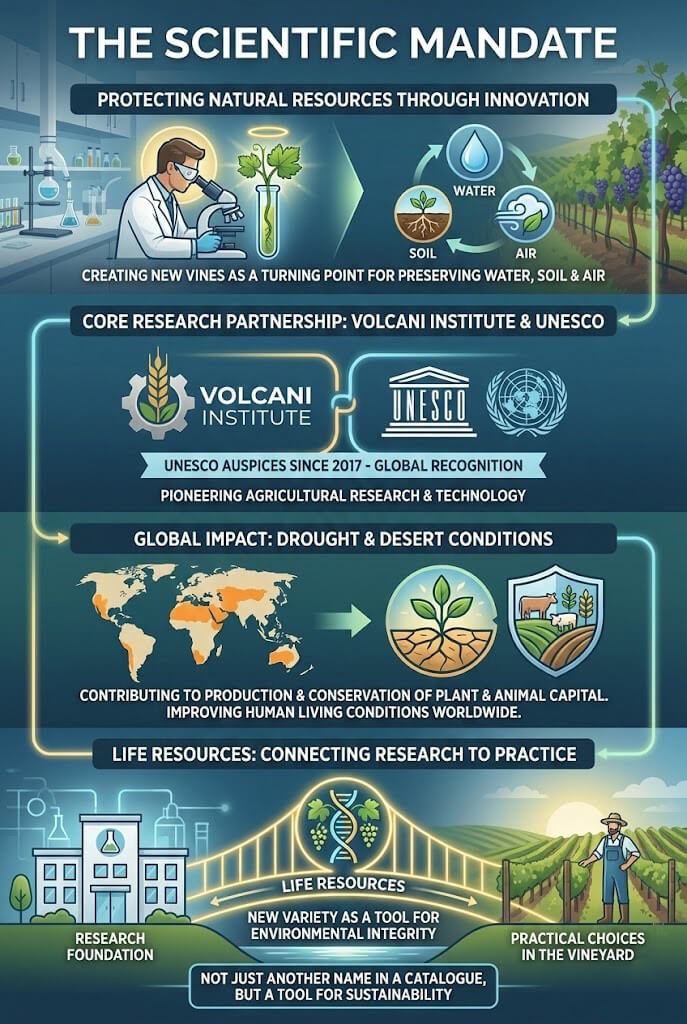
A major part of the responsibility for protecting natural resources lies in the hands of the scientific community. The ability to create a new vine—a new life—can become a turning point in how water, soil and air are preserved.
This belief is reflected in Grape Evolution’s core research partnership. The Volcani Institute has been under UNESCO’s auspices since 2017, recognised globally for pioneering agricultural research and technology. Its work contributes directly to the production and conservation of plant and animal capital in areas affected by drought or desert conditions, improving human living conditions worldwide.
Life Resources connects this research foundation with practical choices in the vineyard so that each new variety can become a tool for environmental integrity, not just another name in a catalogue.
Better vine, better climate
Commitment to resource management and sustainability is translated into clear environmental impact KPIs. The focus is on genetic efficiency—designing vines that support the climate balance directly at farm level.
Water conservation
Diploid varieties in the programme are selected and advanced with water efficiency as a core requirement. Many of these varieties are able to achieve meaningful reductions in irrigation water consumption compared to common industry standards, without sacrificing yield or quality. By combining suitable rootstocks, adapted canopy management and water-wise genetics, Life Resources helps growers move towards irrigation strategies that protect both vines and aquifers.
Carbon efficiency
Genetic efficiency is combined with minimal spray requirements at critical stages such as flowering and sizing. Fewer passes in the vineyard, less tractor movement and lower chemical input all contribute to reduced emissions per kilo of grapes produced. The goal is not to claim a perfect number, but to consistently move the carbon footprint of a grape programme in the right direction—backed by measurable, field-level changes rather than marketing slogans.
Resource-aware agronomy
Life Resources encourages agronomy protocols that respect the limits of each environment:
- Matching varieties to regions where they can thrive with fewer interventions
- Designing pruning and canopy systems that make better use of light and air flow
- Integrating soil health and organic matter management into long-term planning
These choices, combined with genetics, turn sustainability from a theoretical concept into daily practice.
Sustainability and Grapeconomics
Environmental integrity and Grapeconomics are not separate ideas. Varieties that use less water, need fewer sprays and fit better with modern vineyard systems also help stabilise costs and margins over time.
Life Resources works alongside Grapeconomics to ensure that:
Environmental KPIs are considered when advancing new varieties
Growers can see both climate and cost benefits from adopting new genetics
Long-term farm viability is treated as part of sustainability, not as an afterthought
A commitment beyond the season
Life Resources is a long-term commitment rather than a marketing theme. It influences how new varieties are bred, how they are evaluated and how they are recommended to growers.
By aligning scientific innovation with resource management, Grape Evolution aims to support vineyards that stay productive, resilient and respectful of the environment—so that the land, the farmers and the consumers can all share a future in common.